Appearing each issue, Book Briefs lets LTEN members share tips and takeaways from their favorite business books. Hopefully you'll find inspiration and recommendations for your professional library.
Reading a training-compatible book that you'd like to share with your LTEN colleagues? Reach out to us at [email protected] and we'll help you provide a Book Brief.
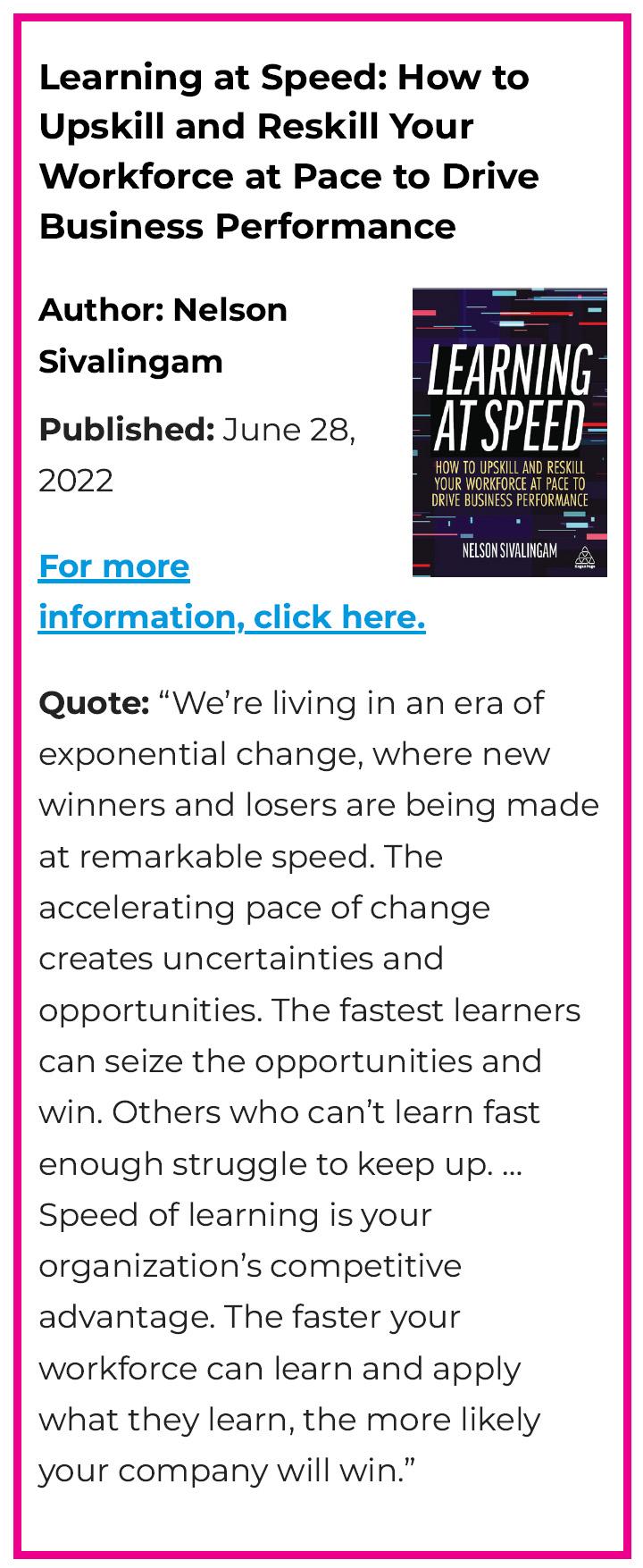 Learning at Speed - Nelson Sivalingam
Book briefed by Sharon Lustig
Changes for our customers are happening quickly, technology is evolving at warp speed and talent gaps will widen if we can’t keep pace. Learning at Speed serves as both a nudge and a roadmap for learning leaders who are navigating these rapid shifts.
Like other books we’ve read lately (The Trusted Learning Advisor by Keith Keating), Learning at Speed declares that learning and development (L&D) cannot be a supporting player. L&D is a business-critical driver that must operate with agility and speed, pivoting with its customer demands.
Author Nelson Sivalingam describes a path to lean learning and a business impact function that behaves more like a start-up. His frameworks focus on fast, focused-learning that fits within the flow of work — without sacrificing quality.
This book doesn’t just talk theory. It’s a call to action with strategies, stories, case studies and templates, encouraging:
- Finding the problem that needs solving. Is training really the solution?
- Tapping into what already exists to close gaps quickly and then iterate to perfect and activate.
- Leaning into microlearning and peer-to-peer learning to create communities of learning, support and performance support tools.
- Ensuring your learning solutions happen at moments that matter.
- Infusing agility and experimentation into ADDIE (Analyze, Design, Develop, Implement and Evaluate), supporting innovation.
- Using AI to elevate the role of L&D professionals.
- Measuring often to improve quickly and to support the L&D brand and its position as a business driver.
Sivalingam’s concept of minimum valuable learning encourages starting small, testing quickly and iterating often. Like the world of start-ups and their “minimum viable product” approach, innovation comes quickly as feedback and results are available.
Learning at Speed is a tactical playbook for leaders who want to move in step with the pace of industry change. Not every concept will fit your organization, and I didn’t agree with every aspect, but it’s a great read for L&D leaders who like their strategy with a side of action.